Home icon

Getting Started

Your Beginner's
Guide to Golf

Everything you need to take that first step — in plain English, without the intimidation.


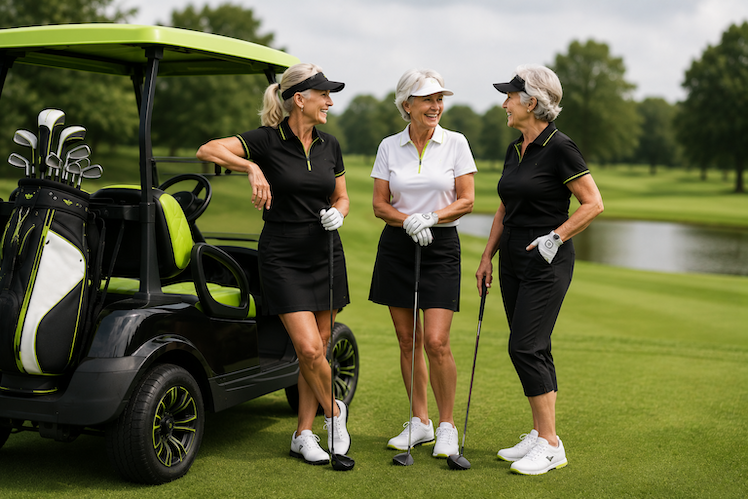
Women on the course

Golf Is for You

Let's get one thing straight: golf has no age limit, no fitness requirement, and absolutely no requirement that you've ever held a club before. The sport has a reputation for being exclusive or difficult to get into — especially for women — but we're here to tell you that reputation is outdated.

The Good Golfer community exists precisely to change that story. Every woman in our programs started exactly where you are right now: curious, maybe a little nervous, and wondering if she'd fit in. They all do. You will too.

💚 A friendly reminder

You don't need to be fit, sporty, coordinated, or young to play golf. You just need to show up. The rest comes with time — and a lot of laughter along the way.


What Is Golf, Really?

Golf is played on a course made up of 18 holes (or 9, for a shorter game). The goal is simple: use a club to hit a small ball from a starting point (called the tee) into a hole in the ground (marked by a flag). You do this with as few shots as possible.

Each hole has a par — the number of shots a skilled golfer is expected to take. Par 3, Par 4, and Par 5 holes each require different strategies. Don't worry about any of this on day one. Just focus on swinging and having fun.

Home icon

The Tee

Where every hole begins. You get a little wooden peg (also called a tee) to prop the ball up for your first shot.
Home icon

The Fairway

The neatly mowed grass between the tee and the hole. Your aim is to keep the ball here — the rough on either side is trickier to play from.
Home icon

The Green

The smooth, closely cut grass surrounding the hole. This is where you putt (roll) the ball in for your final shot.


What Equipment Do You Need?

You do not need to buy a full set of clubs before your first lesson. Most beginners hire clubs or borrow a friend's set while they're getting started — and that is completely normal and perfectly fine.

When you're ready to invest, here's what a beginner set typically includes:

Home icon

Driver (1 Wood)

The big one. Used for your first shot on longer holes. It launches the ball the furthest — and it's often the one beginners want to practice most!

Home icon

Irons (5, 7, 9)

The workhorses of your bag. Numbered clubs used for different distances. Higher numbers = shorter distances and more loft (height on the ball).

Home icon

Pitching Wedge

Your best friend near the green. Used for shorter, higher shots — perfect for getting out of trouble or getting close to the hole.

Home icon

Putter

Flat-faced club used only on the green to roll the ball into the hole. Putting accounts for nearly half of all golf shots — worth practising!

👟 What to Wear

Most courses require a collared shirt and tailored shorts or pants — no denim. Golf shoes with soft spikes are ideal but not essential when starting out. Comfortable, flat athletic shoes work fine. A sun hat and sunscreen are non-negotiable in the Australian sun!


The Basics of a Golf Swing - G.A.S.S

There's no getting around it — the golf swing looks simple and feels surprisingly complicated at first. The great news? You only need to get three things roughly right to start hitting decent shots:

  1. Grip: Hold the club lightly — like you're holding a small bird. Not too tight (kills the swing) and not so loose it flies out of your hands. Thumbs should be roughly on top of the club, offering stability. • A little tip: for right-handers, the right hand should be below the left, and vice versa for left-handers.
  2. Aim: Once they've got the grip, place the club head behind the ball, aiming straight at the target. • Standing side-on ensures the body and club remain parallel to the target.
  3. Stance: Feet shoulder-width apart, knees gently bent, spine tilted forward from the hips (not a hunch from the shoulders). The ball position shifts slightly depending on which club you're using.
  4. Swing: The club should brush the grass, making a clean contact with the ball. • The follow-through should feel natural and relaxed, completing the dance. Remember: the size of the swing determines the distance you'll hit it. Small swing = small distance Big swing = big distance.

✨ Pro Beginner Tip

Stop trying to hit it hard. The more you try to "smash" the ball, the worse it goes. Focus on a smooth, rhythmic swing and the ball will travel further naturally. Every experienced golfer learned this the hard way.


Golf Etiquette — The Unwritten Code

Golf has both formal rules and an informal code of etiquette that every player follows. The etiquette side is arguably more important as a beginner — it's how you earn respect on the course and feel confident in any group.

  • Be quiet when others are swinging. Stand still, don't talk, and avoid making noise on anyone's backswing.
  • Keep pace. Try to keep up with the group ahead. If you fall behind, invite the group behind you to play through.
  • Repair the course. Fix your divots (chunks of turf you remove), rake sand bunkers after use, and repair ball marks on the green with a tee or repair tool.
  • Tend the flag. Remove (or "attend") the flagstick when a playing partner is putting from close range.
  • Don't walk on another player's putting line — the path between their ball and the hole on the green.
  • Phone on silent. Calls can wait. Your partners' experience can't.

How to Actually Get Started

Here's the simplest possible path from "interested" to "playing":

  1. Take one lesson. Even a single 30-minute lesson with a professional teaches you more than hours of YouTube watching. It sets up good habits from day one.
  2. Visit a driving range. Practise hitting balls in a low-pressure environment. No course etiquette to worry about — just you, a bucket of balls, and some swings.
  3. Play a par-3 course or pitch-and-putt. Shorter holes, relaxed atmosphere, and a real taste of actual golf without the full 18-hole commitment.
  4. Join a beginner group or ladies' day. Most golf clubs run social sessions for women of all skill levels. The Good Golfer programs are designed exactly for this.
  5. Play your first full round. With a friend or in a structured group — your first real 18 holes is an experience you'll never forget.

Ready to Find Your Starting Point?

Take our free 2-minute Golf Confidence Quiz and get a personalised roadmap for your journey.

Take the Quiz →    Read: Your First Round →